Listen and subscribe to us on your favorite podcast platform:


Every one of those [petrochemical] materials floats on water. So if the flood waters reach your home but they’re only an inch deep, you’re still contaminated for a long time.
Rob Rogers, founding partner, Rogers Partners Architects+Urban Designers
Eighteen years after Hurricane Ike showed the catastrophic storm-surge risk to the Houston area’s industrial and petroleum complex, architect Rob Rogers is making the case for a storm barrier inside Galveston Bay. Built largely from material dredged from the Houston Ship Channel, it would double as a public park.
Why it matters
When Ike hit, Texas refineries holding about a fifth of U.S. capacity shut down, and gas ran short as far away as Atlanta. The federal plan to protect the channel is still in design.
The question
How do we maintain the public will to pay for protection when the last disaster is fading from view?
Why here
On the I-10 corridor’s Gulf Coast, the Coastal Texas Project—the “Ike Dike”—is what Texas Land Commissioner Dawn Buckingham calls “the largest coastal resiliency undertaking in U.S. Army Corps of Engineers history.”
Rogers Partners developed the Galveston Bay Park Plan with Rice University’s SSPEED Center and engineers at Walter P Moore. Rice put its cost at about $7 billion in 2025.
In this episode, Rob Rogers, founding partner of Rogers Partners Architects+Urban Designers, joins Duke Reiter to discuss what an architect brings to flood protection design, why the Army Corps’ process never produced a plan like his, and what the Ship Channel, like the interstate highway system, tells us about building for generations. This is Part One of a two-part series on who pays to protect the Texas coast. In Part Two, Bolivar Peninsula resident and advocate Brenda Flanagan and Michel Bechtel of the Gulf Coast Protection District talk about the peninsula’s engineered sand dunes and who maintains them.
DUKE REITER
Afternoon, Rob. Welcome to Ten Across Conversations. Really glad to have you. So we’re going to be talking today about a major infrastructural situation, which frankly has implications for a region, for the nation, and even the globe. It has to do with the Houston Ship Channel and a lot to do with energy, where it comes from, how we process it, how we get access to it, but also how the infrastructure we build for that is being impacted by climate change in a whole number of ways, which I’m sure we’ll get into here, and your recommendations for some solutions about how that might be handled along the Texas shoreline. But before we do that, tell me a little bit about how an architect gets involved in such a project.
ROB ROGERS
Our practices originated in New York, and we have an office in Houston as well. And we’ve always worked across disciplines, architecture, landscape, and urban design, feeling like those are kind of artificial divisions, you know, where does it stop? The space between buildings is every bit as important as the buildings themselves.
And so that practice led us to getting involved post-9/11 in Lower Manhattan and getting involved with providing security infrastructure around the New York Stock Exchange, but humanizing it, you know, and sort of the idea was, how do you make a place that’s safe for what all the risk factors are, but is also something that treats tourists, workers, everybody with respect and grace?
What happened is we were doing work down at Rice University on a new building for the social sciences, and I got to know a whole bunch of people involved down there, engineers that were working on things, that were on the faculty, and they came and said, we’ve been working on this idea, but we don’t know how to visualize it. And could you help us? And these were Phil Bedient, Jim Blackburn, guys from the SSPEED Center at Rice University, and Charles Penland from Walter P Moore.
And so we joined that group, and they had started an idea about a levee that would be in Galveston Bay itself, rather than out at the coast. And as we got involved, we began to talk about it in terms of economic development, hurricane surge protection, environmental impact. And we kind of brought along from our practice. We said, well, you know, one of the things we learned about security infrastructure is it’s only going to be rarely used and maybe never, but what’s its impact every day? And that’s when we evolved the idea of saying, if we’re going to build this thing, let’s make it a public park. So it’s got a function in daily life for everybody.
DUKE REITER
But remind people why the ship channel is so important to the region, again, the nation, and even what’s happening in the globe right now. I mean, what are we talking about with regard to Ukraine and diesel and what’s happening in the Middle East? Energy dominates a discussion of contemporary life. Why is this location so crucial?
ROB ROGERS
Well, let me actually, I love to talk in the present, but I’m going to start in the past, right? The origin of the Houston Ship Channel is, Galveston was the third busiest port in the United States at the turn of the century, 1900, and it was completely obliterated in the hurricane of 1900. And the founding fathers of Houston said, why don’t we build the port in Houston and dredge a ship channel from Galveston to Houston and have a protected port?
And that coincided with the opening of the Panama Canal, and also the discovery of oil in Texas. All of those things happened around 1912, 1913, 1915, and Houston’s birth story is that coincidence of energy, transportation, location, you know, warm-water port, all of those things happening. And so fast-forward 100 years, you’ve got Houston as the epicenter of energy production in the United States.
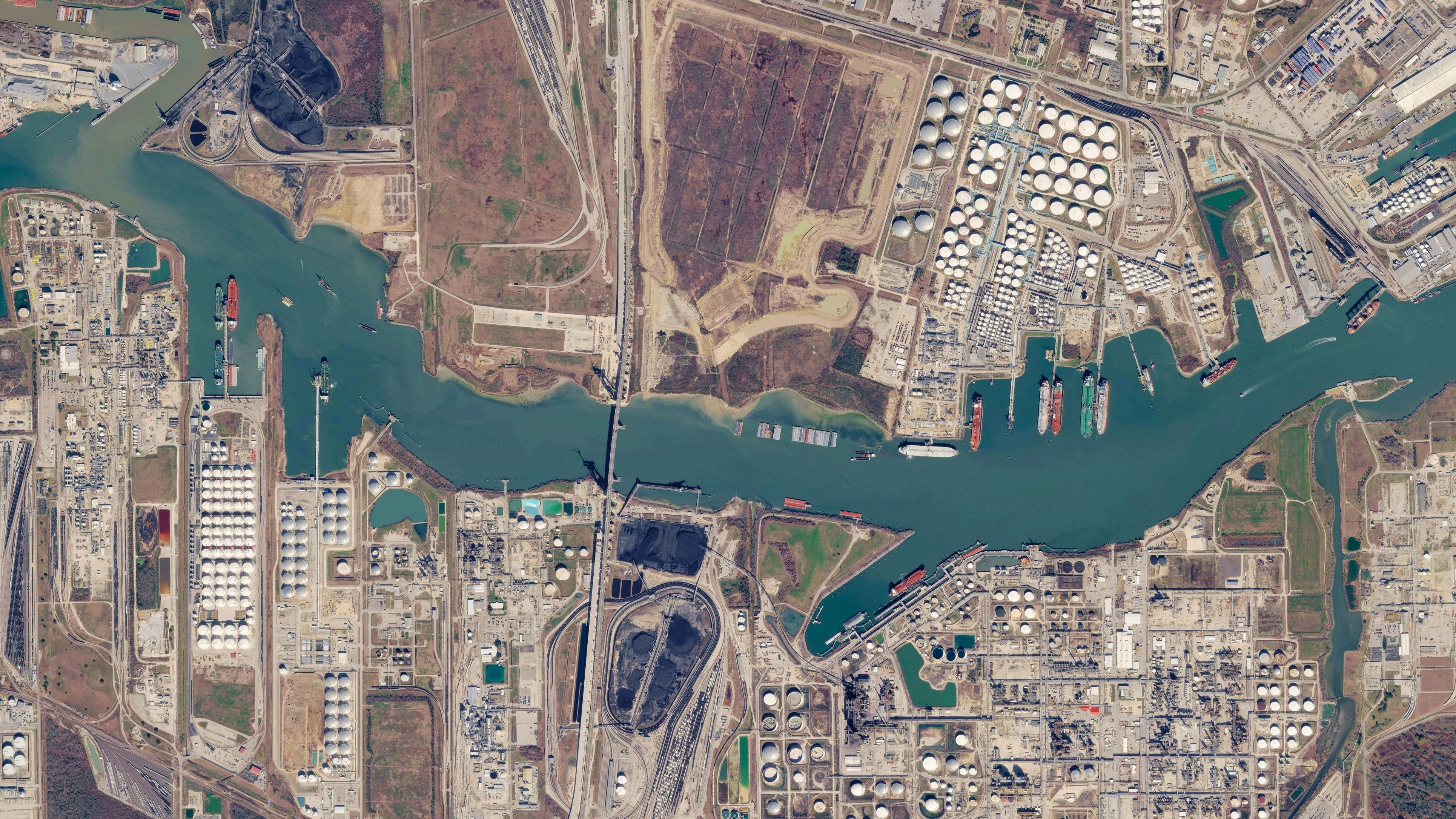
Almost 25% of the production of all petrochemical activity in the United States takes place in Houston. And essentially that’s at the Port of Houston and in the ship channel. So it’s a huge concentration of production, of storage, of shipping. And when you speak about the changes over time, it’s also become one of the major exporters of LPG in recent years. So it really continues to be at the center.
DUKE REITER
So the balance between the industry and, if you will, the residents, some of whom we’ve spoken to, and their concerns or observations, tell us about that duality in terms of the protection of the citizens and the economy.
ROB ROGERS
The idea for Galveston Bay Park, right, is essentially an archipelago of islands, built, man-made islands, built into Galveston Bay that would protect Houston and the close region, the heavily populated areas in the northeast of the northwest of the bay, from hurricane surge. And so that’s both population protection as well as industry.
And one of the things we talk about is the millions of gallons, the whole full range of petrochemicals are all stored in and around there. And so you can imagine if you had a major hurricane surge, that you begin to disrupt some of those tanks into the refineries. Every one of those materials floats on water. So if the floodwaters reach your home, but they’re only an inch deep, you’re still contaminated for a long time.
DUKE REITER
My experience in New Orleans was a lot about that. Hurricane Katrina, and what was in the water was, in many cases, toxic, dangerous. But it’s nothing like the amount of material that’s stored around the ship channel and in Houston. And so you’re so right. It’s not just the level of water, it’s what’s in it.
If this hurricane, which we could imagine, comes up through the bay, hits the channel, hits Houston, we’re all going to feel it. And it could be for a considerable length of time. Thus, the urgency to produce something that provides more protection is essential. But as you’ve been working through since Hurricane Ike, which is how the Ike Dike got its name, we’re approaching 20 years of processes. Talk about, since you’ve been right there thinking along with others about how to get something done, how do you bring that sense of urgency to policymakers and governmental procedures which aren’t inclined to see the urgency maybe the way you do?
ROB ROGERS
It’s tough. I think when we get into conversations, there’s a lot of people that understand, if they’re invested in a broader understanding of what’s happening in the world and with the oceans, that the hurricanes over the last 20 and 30 years, they’ve gotten bigger and they grow faster and they’ve gotten stronger winds. I mean, look what we just saw: Mobile. And that is evident. And even though we had a light hurricane season this year so far, you know that it’s going to happen. You know, you can’t remove it from the statistical…
And when you take Ike, the surge up the Houston Ship Channel was about 14 or 15 feet deep. And most of those places are protected to 15 feet. And they’re all independently protected. They don’t share resources. They don’t say who’s where and how. It’s actually very protected information. And I don’t know. You got a 14-foot surge and 15-foot protection. It’s Texas, so I like to use Texas parlance and say that’s like having your ear shot off. You know, you ought to be aware that if it gets any closer, you’re done.
DUKE REITER
You know, let’s describe for people the ship channel and the need for constant dredging in a bay. And you’re suggesting, yes, that needs to go on. But you were just describing how that material could be used to create landforms that are both protective of the bay, but also creating amenities. But make sure that I have this right. The channel itself must be constantly cleaned up, if you will, and dredged, and that material has value as you see it.
ROB ROGERS
The majority of the bay is, you know, 10 or 12 feet deep. And so when you’re talking about bringing these huge ships, container ships, tankers, everybody in, what they’ve done is they’ve literally dug like a canal almost within the bay itself that is wide enough and deep enough to take those ships. And you’re right, because it’s tidal and things are moving, you’ve got maintenance dredging that has to go on all the time. And so that’s a material that needs to be dealt with. It’s environmental processes and permitting that have to be executed.
And one of the things that we were saying is that we actually have to dredge wider and deeper, and that means you’re in virgin clay, which is the right material to build the levee. But then we also say we believe that this source can become the location for the maintenance dredging over time, and that radically enables the port to simplify its environmental permitting. And that’s because they’ve got a ready place for the next 50 years. When they dredge, they know where it’s going to go. They know how it’s going to work.
And these are all things that create very significant economic opportunity for the Port of Houston. And if you look at the statistics, you know… One of the things that we really love about the idea of the Galveston Bay Park, and one of the reasons it gets traction, is that, as you mentioned, we’re combining public safety with public amenity, but it’s also an economic development engine, right? Just in the same way that the first ship channel, which was one of the first public-private partnerships in the history of the United States, delivered economic capacity to Houston. The ship channel continues to be this vital thread. And to take in the bigger, larger, more ships, you know, make it wide enough so that the big ships can actually pass each other. There are times they have to operate the ship channel in one direction only because of the size of the vessels.
And so if you increase the capacity of the ship channel, you’re really enabling, I like to say, the next 50 years, the next hundred years of Houston as a center, global center, really. And that material is being used immediately adjacent to where it’s being taken out to create this set of islands. So it’s the least environmentally disruptive, least expensive way to create economic production. And it’s those layering of ideas, right? That’s where for me, I like to say, as I matured as an architect, it’s not so much about making forms. It’s aggregating expertise to execute ideas, you know? And that’s kind of what I see [in] Galveston Bay Park.
DUKE REITER
Just so our audience understands this, having described the ship channel and the need to dredge, so our audience understands this, you’re now getting into clay and other materials. Your proposal, which probably wouldn’t come from the Corps of Engineers, is to take that material and create, if you will, islands alongside the ship channel that creates, if you will, a park. And this is now the public amenity you’re describing, the economic development engine that could result from this in a place that doesn’t have enough access.
So for people to understand what we’re doing here, we’re taking a necessary engineering process for ships and turning it into something unexpected, frankly, running through the bay, where I could bicycle, walk. Maybe there’s a road there I could drive. I could suddenly engage this area in a way that I can’t currently do.
ROB ROGERS
Absolutely. And it’s also an environmental project, because almost the entire western side of the bay is either riprap, sheet pile, or seawall. And so all of the activities of filtering and, you know, the grasses and the edge, that edge has all been hardened. And we are going to recreate 25 miles of green edge.
There’s only 500 acres of public access to Galveston Bay. Everything’s privately owned and managed. And this would create 10,000 acres of publicly accessible land that’s bayfront, for boating, for fishing, running stables and campgrounds. You’re not going to build a lot of things that can’t weather a storm, right? So it’s a lighter touch. It’s landscape. But you’re really making use of this feature all the time, which is going to improve water quality. It’s going to enhance the fishery and the ecological inhabitation of the bay itself.
And so one of the reasons it hasn’t come out of the Army Corps study is the Army Corps methodology is legislated, and they’re required to do certain cost-benefit analysis. They do these kind of things, and it comes up with the kind of more single-line infrastructure, right, that they’re used to. And this is a kind of, we hope [people] don’t see it as radical. It’s just simply a more interesting advancement of layering these different issues together into a single solution.
DUKE REITER
If you look at what’s happening on the California coast right now, which is also part of the territory we look at, whole beaches are being moved away. When you see California, Mobile, people watching those situations, do you think they take what you’re proposing a bit more seriously and say, Rob is right, we need to get ahead of this now? Look what’s happening when we don’t do it.
ROB ROGERS
I would hope so. I mean, I think you’re touching upon a national conversation of how forward-looking we really are, because these projects are not going to get done without federal participation as well as local participation. And right now, as you may know, the state of Texas has created the Gulf Coast Protection District, and they’re the ones that will be the local, both funder and, in the end, they’re going to own it, right?
And the state has put hundreds of millions of dollars into that pot already, looking at research, a lot of the work that the Army Corps is doing on the coastal barriers, the Ike Dike, as it’s often called, and the design of the gate system at Bolivar, where the bay, you know, meets the Gulf. And so we need to have more forward-looking thinking coming in Washington, in all branches, to be talking about what this could mean.
And sometimes people are intrigued with the concept of the park. Sometimes they are intrigued with the economic development of widening the channel. Sometimes you say, look, 45% of the military-grade fuel in the United States comes out of Houston. If you knock that out, what have you just done to national security? You know, I mean, one of the things we try to do is gather people with the right set of ideas so that we can offer the kind of information that people will find is compelling to that particular point of view. And if you can get that broad enough, you begin to build your constituency around, this is a good idea.
One of the funders of our work is actually an industrial investor that’s on the bay. And when he heard about dredging the channel and building this thing right next to it, he said, the most logical thing I’ve ever heard of, why would you not support that? And he owns and operates in the port area. And so that’s really part of our effort, is to get it out there and get people behind it, so you get your politicians behind [it].
DUKE REITER
And sometimes they use that, if you will, against us. You know, that’s Rob or Duke imagining this thing. What does the Corps have to say? What do the engineers have to say? How do you sort of temper that to make sure people understand that, no, I am talking about economics, I am talking about logical development? Because we have reputations, so to speak.
ROB ROGERS
Yeah. I don’t know that it’s you and I that have the reputation, but there are some radical form makers whose work we know well, and it’s kind of like, hey, what’s the craziest thing I can possibly get somebody to build? And my practice has never been in that nature. I have a deep belief in the quality of the public realm, of the behavior and necessity of cities, and so that work comes from that. In the same way that really great work in cities comes out of community engagement and community involvement.
DUKE REITER
Putting money towards the thing that won’t happen is difficult, right? Putting money towards the thing that did happen, and now we got to clean up the mess, people understand.
ROB ROGERS
And that’s where, in the disciplines in which we’ve trained, we look at long periods of time. A lot of times when we start working on a building, it may not get executed and [the] building occupied for eight years. And so these are the windows that we are used to and look to. But, you know, the general population and the political will operates on a quarterly stock report. And that is where you need the right kind of leaders, understanding that when you’re looking at these kinds of risks…
And it’s really interesting, because we do find really forward-thinking people coming out of the Army Corps and other places where they are trained to say, I’ve got to protect bases overseas. They’ve got a kind of attitude about, we need to expend for security. And I think what we try to do is equate that security, you know, the kind of idea that when nuclear facilities in the United States are required to be protected to the degree of a thousand-year storm, why on earth wouldn’t you do the same thing for the Port of Houston?
So using examples, presenting things of that nature, where you can help others look at a longer window, realize the risk in the thing. And I see this in a very similar way. This is: get the region to embrace it so that it becomes understood to be of national importance. What you can do is you can speak clearly and to people’s, I don’t want to say capacity, but let’s say speak to their interests, so that you begin to let them own the idea.
DUKE REITER
Yeah. And the long-term benefit, well beyond what you and I will experience in our lifetimes. As a mayor locally said to me about a project we’re working on, we’re working on the shade that will be provided by the trees that we’re planting now. That will be our grandsons or granddaughters or great-granddaughters. Thinking in those kinds of terms is a design project. Looking at constraints and trying to make the best of them is a design project. And I think what you put together here is an extraordinary design beyond just the physical presentation of what can happen here.
ROB ROGERS
And one of the reasons I tell the story of the hurricane of 1900 is that was visionary. To dredge that channel from Galveston to Houston and say we’re going to remain the biggest port on the Gulf Coast, that took vision. And it had to be something that said, I’m doing something for multiple generations. This is not because I’m going to make a buck tomorrow. It’s because that’s going to enable this city to survive the next hundred years. And I think this is that order of magnitude of infrastructure.
DUKE REITER
But now, once you build it, you own it, and everything about it, and maintaining these things, and deciding that public dollars or private dollars need to be expended on their maintenance. So I think your project falls in that category of great things that have been done in this country that demonstrate our desire to be in these locations, as difficult as it might be.
ROB ROGERS
Yeah. And it’s amazing. Of course, you are referencing I-10 and the vision to build the interstate highway system from Dwight Eisenhower. We’ve learned that maybe it went a little abruptly [through] places. That was tough.
DUKE REITER
Especially in Houston. The story of the 10 in Houston is legendary.
ROB ROGERS
Yeah. But the infrastructure got built, and it created a huge economic, really, the economic boom of the ’50s of the United States was enabled by investment in infrastructure. And that story is the same as the original ship channel. And so I kind of go back to that.
And then sometimes, to your point about, well, why do you need an architect to do that? I go back when we were working on some of the security improvements, right, the New York Stock Exchange, the Pentagon, near the White House. These are really special cultural monuments and places of national importance. And most of the time, the things that we were doing to try and create an improved public realm, maybe 5% of the cost at most, because everything was in the infrastructure, in the operations, in the way that it changed how people were spending time and doing things.
And so to me, that’s a terrific value proposition. You know, to get this, we’re going to spend 95% of the cost to build this barrier, and for 5%, you’re going to get this amazing park. What a deal.
DUKE REITER
Right. Yeah. And by the way, the story of flooding or water inundation leading to an engineering solution that later is observed to be less than what it could have been results in things like, you know, the River Walk in San Antonio, or the LA River improvements, or what we’re trying to do here with Rio Reimagined. First, we attend to the immediate need. Let’s stop the flooding. Let’s put up floodwalls in New Orleans. And now you’re seeing parks emerge along the Mississippi riverbanks, which can be, like your project, both-and: protective barriers and also amenities. I just think there are many examples in this region of that both-and example.
ROB ROGERS
Absolutely. And that’s the crux of it. So we need to move it up the ladder.
DUKE REITER
There you go. There you go. Well, Rob, we really appreciate this conversation with you about your work, your steadfast commitment to it, bringing the eye of a designer to something that could easily have been perceived as simply an engineering project to achieve a certain end. You’ve expanded the definition of what’s possible. So we really appreciate your work and your willingness to share it with us.
ROB ROGERS
Absolutely. These are the kind of things, like I would say, this is why I am an architect, is so that you can make contributions to your people, to your society, to your country. You know, it’s a pleasure. And thank you.
DUKE REITER
Yeah. On a generational scale. So we appreciate everything you’re doing. Rob, it’s been great to chat with you.
ROB ROGERS
Thank you so much.
Relevant Articles and Resources
- “Massive Galveston Bay Barrier System Gets One Step Closer to Construction” (Public Health Watch, February 2026)
- “Texas Leads Bold Push to Build ‘The Gate’” (Texas General Land Office, December 2025)
- “Rice’s SSPEED Center unveils Galveston Bay Park Plan: A comprehensive solution to hurricane storm surge threats” (Rice News, May 2025)
- “Houston Ship Channel Ranked #1 U.S. Waterway” (Port Houston, May 2025)
- “Galveston Bay Park (Houston-Galveston Area Protection System)” (Rogers Partners)
- “Post-Ike gas shortage may take weeks to end” (Christian Science Monitor, September 2008)
- “Hurricane Ike idles 21% of US refining capacity” (Oil & Gas Journal, September 2008)
Relevant Ten Across Conversations Podcasts
- Negotiating Survival: The Complex Decision-Making Required to Save Louisiana’s Coast
- Katrina’s 20th: Jeff Hébert on Community Recovery and Resilience
- Addressing Historical Inequities in Our National Infrastructure, Then and Now
- How Houston Texas Reveals America’s Future with Kyle Shelton
Credits
Host: Duke Reiter
Producer and editor: Bryce Cristiano
Research and support provided by: Kate Carefoot, Rae Ulrich, and Sabine Butler
Guest Speaker
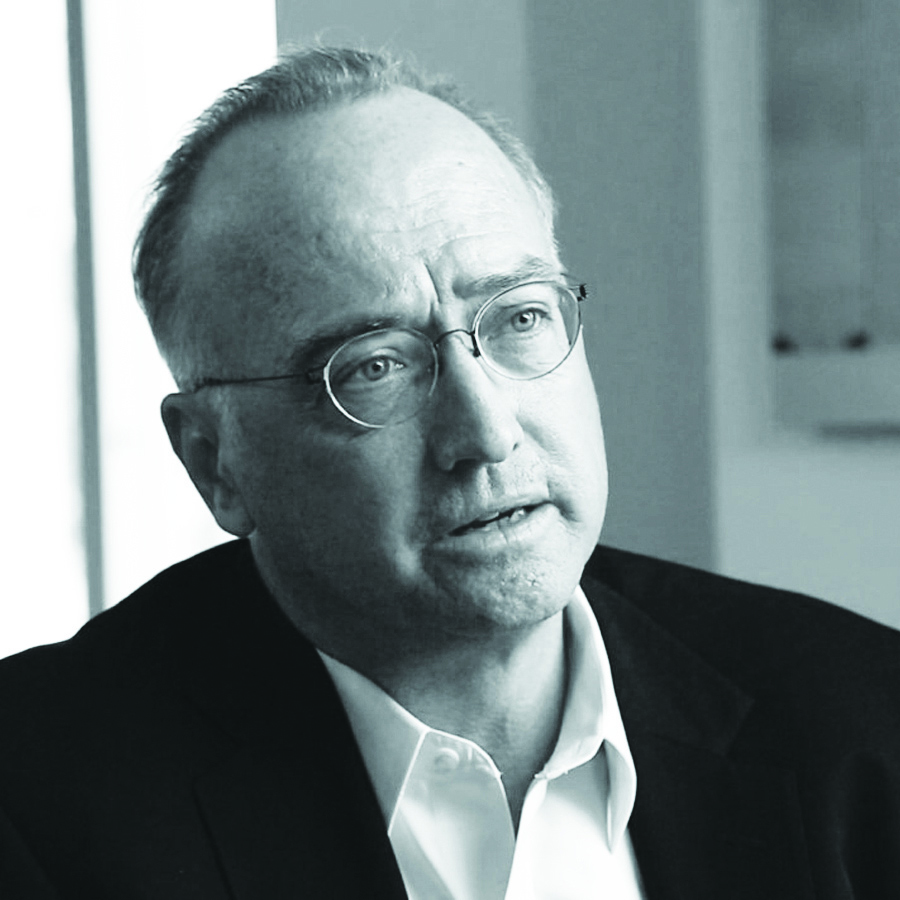
Rob Rogers, FAIA, is the Founding Partner of Rogers Partners Architects+Urban Designers and has served as professor and architecture critic at prestigious design schools and universities around the country. Believing that even a single building is a piece of urban design, his work explores the limits of architecture and the overlap of disciplines: the spaces where architecture, landscapes, and the public realm converge. Designing in cities nationally and abroad, Rob is committed to design excellence, creating work built on research, analysis, discovery, and shared experience.