by Maya Chari
APM Research Lab Ten Across Data Journalism Fellow
Students are still recovering from pandemic learning loss, but unpredictable federal funding is forcing schools across the Sun Belt to cut teachers, drop programs and delay the interventions experts say are urgently needed.
Five years after the start of the COVID-19 pandemic, American students are still underperforming relative to 2019. According to a report from the Brookings Institute, students’ math scores are slowly recovering, but reading scores continue to decline. The Institute concluded that “the pandemic created gaps that, under ideal circumstances, would take multiple years of intensive, high-impact interventions to close.” But inconsistent access to funding makes it difficult for schools to address the problem.
This is a particular issue for states along the I-10 corridor. Many states with the lowest rates of adult literacy, including New Mexico, California and Texas, are located in the southern part of the country. Every state in the region is dealing with significant teacher shortages.
Meanwhile, the Trump administration is significantly curtailing federal education funding. The teacher trade publication EducationWeek documented more than 730 federal grants, collectively worth over $2 billion, that were discontinued or terminated. In July 2025, the Trump administration announced that several more grants — totalling $6.8 billion in federal funding — had been frozen and would not be released to states. The announcement came mere hours before the states expected to receive the funds, which had been approved by Congress that March in a resolution signed by President Trump.
The affected grants include:
- Supporting Effective Instruction State Grants, intended to recruit, train and retain teachers and principals;
- 21st Century Community Learning Centers, a source of funding for before- and after-school programs;
- Student Support and Academic Enrichment Grants, which fund a variety of activities and infrastructure including accelerated learning programs, college and career counseling, guidance counseling and technology infrastructure;
- English Language Acquisition State Grants, intended to support students who are learning English;
- Migrant Education Program, intended to support children who move from state to state;
- Integrated English Literacy and Civics Education State Grants, which fund adult education programs.
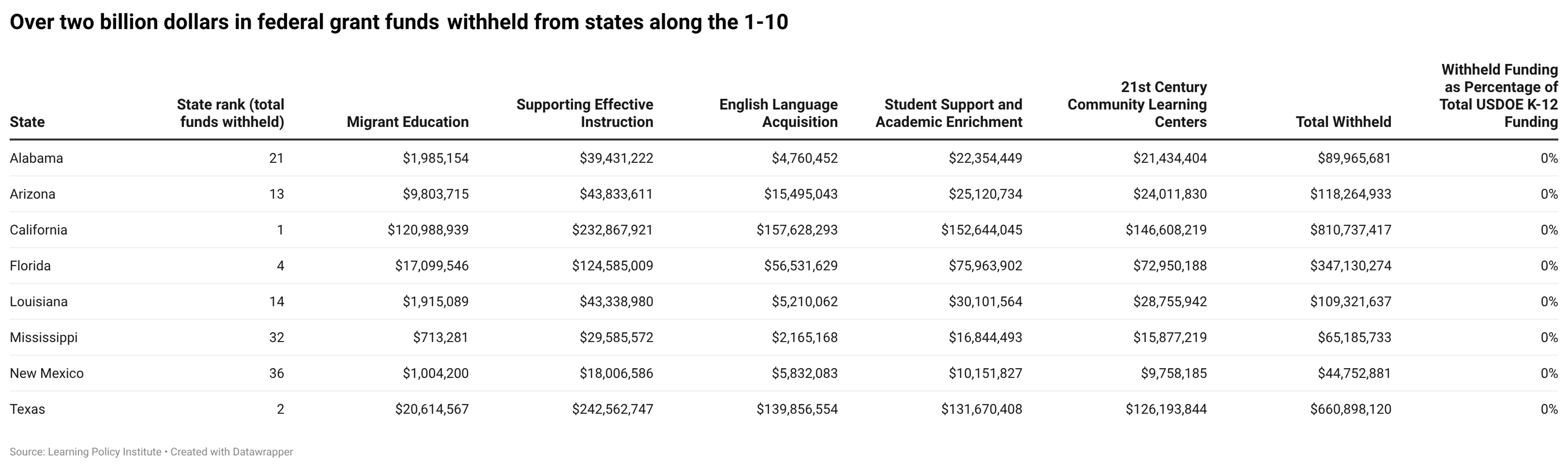
California, Texas and Florida were among the states with the most funds frozen, both in terms of dollar amounts and respective percentages of the total approved federal funding.
The administration’s stated reason for the freeze was to review grants to ensure compliance with executive orders. In April, the Department of Education sent a letter to grantees requiring that they certify the funds would not be used for diversity, equity and inclusion (DEI) activities. Enforcement of this condition, however, was deemed unconstitutional by federal judges.
Schools tend to set budgets over the summer, with fiscal years starting at the beginning of July. The last-minute freeze left school districts to start a new year with no margin to accommodate such significant shortfalls. Ten Republican lawmakers, led by Shelley Moore Capitoof West Virginia, signed a letter to Russell Vought, the Director of the Federal Office of Management and Budget, asking him to release the funds.
On July 21st, the administration released funding for the grant supporting after-school programs. By the end of the month, they’d released the remaining funds. At that point, however, some school districts had already resorted to cutting jobs, discontinuing programs or reshuffling staff.
Leah King, an animal science teacher at Vista Ridge High School in the Austin suburb Cedar Park, said that her school district had already been struggling financially due to state-level budget issues. The federal funding freeze immediately intensified the strain..
“The first day of school, it was like, this is going to be bad. And it just didn’t stop,” she said. “We’re getting slammed in every direction.”
King said her school is better off than most in Texas, due to its location in a relatively wealthy area. Still, the district cut over 200 positions in 2025, including about 150 teachers.
“At every single professional development meeting, it’s how we’re going to have to cut more, we’re going to have to fundraise more to do the things we’ve always done, we’re going to put more kids in your class, we’re going to have to stack classes,” King said.
As a result, King plans to leave teaching after this year.
“I’m tapped out,” she said. “I’m done. The stress levels have just gradually gotten worse. The conversations have continually been, how much more can you squeeze out of me? It’s time to bounce. And I know for a fact there’s a large quantity of teachers who are doing the same thing. Which is sad.”
The Sun Belt is the fastest-growing part of the country, both in terms of population and GDP growth. But income inequality is growing, and graduation rates are falling. The future success of the region might well depend on attention to education funding at every level of government.