by Maya Chari
APM Research Lab Ten Across Data Journalism Fellow
This week, the American Lung Association released the 2026 edition of its annual report, State of the Air. It shows that more than four in ten Americans — and nearly half of American children — live in counties with unhealthy levels of ozone and particulate air pollution. Both types of pollutants can cause respiratory and neurological issues. Air quality has an especially strong impact on the health of children, whose lungs are still developing and who tend to have more exposure to outdoor air than adults.
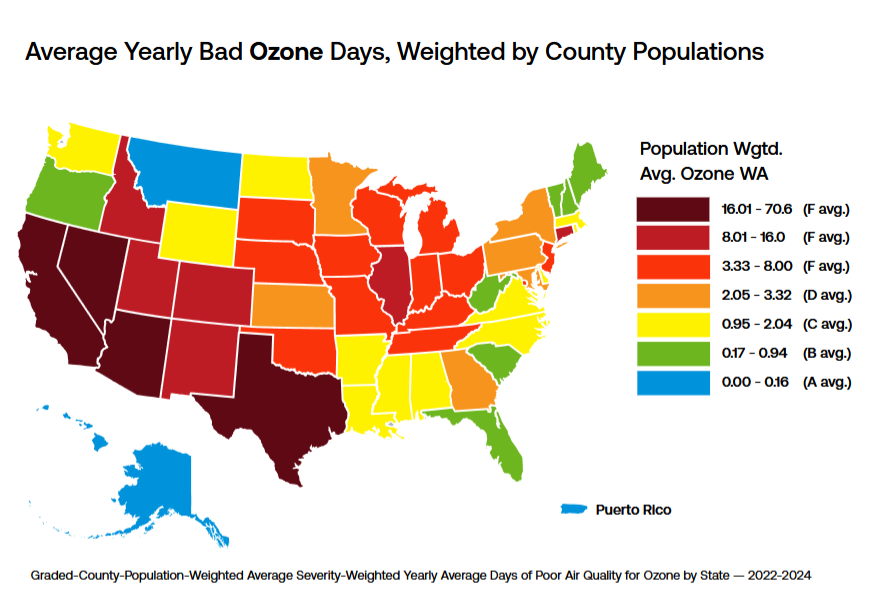
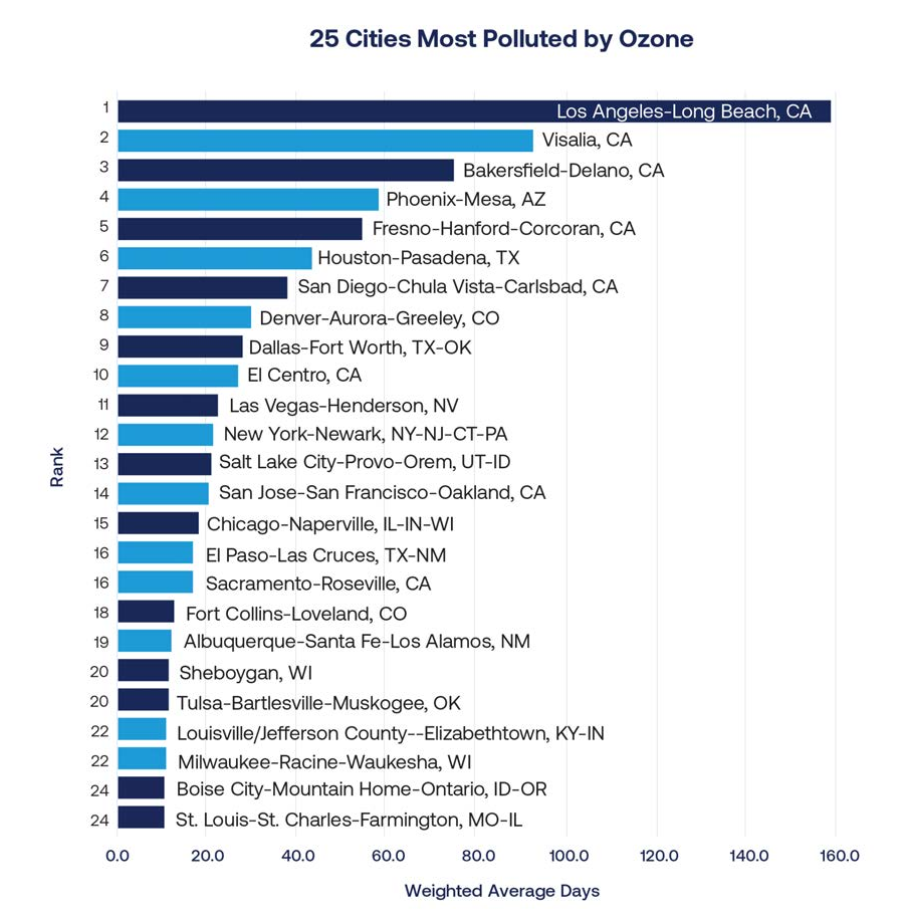
This issue is seen especially clearly in major metros along Interstate 10. Report rankings year after year show that residents of some of the country’s largest, fastest growing metro areas, home to some of the nation’s most influential commercial and industrial interests, are living with potentially dangerous levels of air pollution. In this region at the forefront of accelerating extreme heat events in the U.S., the compounding relationship between high temperatures and air pollution like ground-level ozone creates outsized negative impacts on human health– earning cities like Los Angeles, Phoenix, El Paso and Houston places on the State of the Air’s “Worst 25” lists.
In the Southwest especially, the impacts of climate change are challenging efforts to clean up the air. Over the past two decades, wildfires, which release particulate matter as they burn, have gotten larger and more intense due to increased temperatures and decreased rainfall.
“Compared to last year, the Phoenix area saw no improvement in smoggy days, and actually saw worse levels of particle pollution,” said Melissa Ramos, senior manager of clean air advocacy at the American Lung Association. California’s“inland empire” region, consisting of San Bernardino and Riverside counties, was ranked by the 2026 report to be the smoggiest part of the country.
The State of the Air report is an independent, annually consistent resource with the national reach to inform the public about progress toward protecting people from the most widespread, regulated air pollutants. The report also has natural limitations that are meaningful in the I-10 region. Its focus on pollutants that are both common and commonly reported throughout the U.S. means that its rankings can understate severe air quality risks that may be specific to places like those along the Gulf Coast where oil and gas, petrochemical and similar industries generate highly toxic emissions.
Environmental health reports like the State of the Air typically rely on data collected and reported by the U.S. Environmental Protection Agency. And while the EPA’s role in monitoring threatening environmental factors– air quality in particular– has been established over decades, its work seems to reflect current shifts in the political landscape.
This wasn’t always the case. In the 1960s and 1970s, in response to increasingly visible and dangerous smog in American cities, politicians from both parties harnessed federal-level power and resources to address air pollution. The federal Environmental Protection Agency was established by Republican President Richard Nixon in 1970. From 1963 to 1990, Congress also passed a series of laws intended to regulate air pollutants. These statutes, collectively referred to as the Clean Air Act, regulate levels of pollutants including ozone, sulfur dioxide, nitrogen dioxide, carbon monoxide, and lead in outdoor air. States, localities and tribes are required to submit plans for reducing air pollution to the Environmental Protection Agency for approval.
Between 1980 and 2000, the average American life expectancy increased by a little over two and a half years. An analysis by the New England Journal of Medicine estimated that around five months of that increase was attributable to air pollution reductions under the Clean Air Act.
Further, in 2009, the EPA issued the “endangerment finding,” ruling that greenhouse gas pollution poses a threat to the public welfare. This finding allowed the agency to track and regulate the emission of the six major greenhouse gases — carbon dioxide, methane (CH4), nitrous oxide (N2O), hydrofluorocarbons (HFCs), perfluorocarbons (PFCs), and sulfur hexafluoride (SF6) — from vehicles, the largest source of such emissions.
Recently, however, the second Trump Administration has moved to loosen standards regulating air pollution. In July 2025, the administration exempted over 100 industrial plants, including chemical manufacturers, oil refineries and coal plants, from Clean Air Act standards.
In February, the EPA rescinded the endangerment finding in what it called “the single largest deregulatory action in U.S. history.” The administration cited concerns around economic growth and national security as justifications for rolling back the regulations.
These actions have raised concerns from scientists, lawmakers and citizens. An analysis by the nonprofit Environmental Defense Fund estimated subsequent increases in air pollution could result in up to 77,000 early deaths and $4.7 trillion in expenses. The EPA’s decision is being challenged in court by a coalition of five counties, 10 cities and 24 states, including Arizona, California and New Mexico. In San Francisco, activists and scientists have congregated outside the EPA office in protest.
The administration has also cut billions of dollars in funding awarded to environmental justice projects. Denae King, the associate director of the Bullard Center for Environmental and Climate Justice, said in a session with the American Public Health Association that funding cuts have hindered the center’s environmental health research and advocacy.
“Our community partners really developed their capacity,” she said. “They were ready, they were working. … Now everyone’s asking, ‘what do we do next?’”
The impact of these policy shifts has not yet shown up in the ALA’s annual report, since the 2026 edition draws on data that predates the current administration. What can be seen, according to the ALA’s Melissa Ramos, is that increases in wildfires and extreme heat were already threatening efforts to clean up the air. Additionally, in many Southern and Sun Belt cities, rapid population and economic growth has led to increased vehicle traffic, which brings with it increased particulate pollution. Recent rollbacks of what Ramos called “critical” and “lifesaving” clean air rules will only make the problem worse.
“We’re really making the case for the EPA to prioritize public health again, because our kids deserve to breathe clean air,” she said.The 2026 State of the Air report shows that there is more work to be done at federal, state and local levels. It also provides a testament to the valuable role of non-profit and other non-governmental efforts to pursue the nation’s toughest challenges and to help drive public conversation about solutions.